
Overview
What is Hair Transplantation and who is it for?
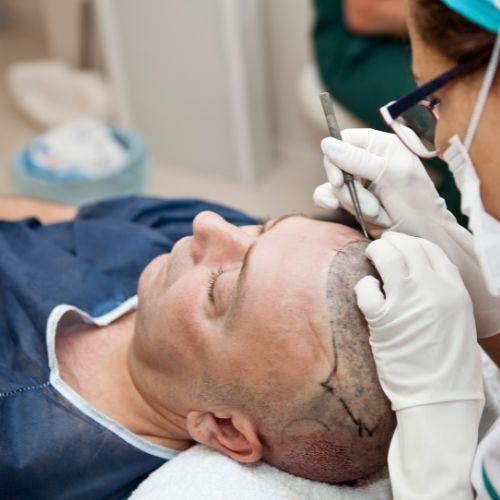
Hair transplantation works on a simple principle. Hair at the back and sides of the scalp is usually resistant to the hormone (DHT) that causes pattern baldness. When these follicles are moved to the front or crown, they tend to keep this resistance and continue to grow. The most common method today is FUE (follicular unit extraction), where individual follicular units are removed one by one and implanted into tiny slits in the recipient area.
Not everyone is a good candidate. Your donor area must have enough healthy hair, your hair loss should be reasonably stable, and your expectations need to match what your donor supply can cover. Younger patients whose hair loss is still progressing may first need medical treatment. Blood tests and a health check are done before surgery to make sure it is safe.
The procedure is done under local anaesthesia and can take most of a day. Transplanted hairs usually shed in the first few weeks, then regrow slowly. The final result takes around a year to show. Medical treatment is often continued afterwards to protect your existing hair. Your hairline and graft numbers are planned to look natural as you age, and you will know what your donor area can realistically cover before you decide.
The procedure
What happens during the treatment?
- 1
Consultation and planning
Dr. Shilpa assesses your hair loss stage, donor density, scalp health and goals, and discusses whether surgery is suitable for you.
- 2
Pre-surgery tests
Blood tests and a review of your medicines are done. A hairline is designed with you and the number of grafts is estimated.
- 3
Surgery day
Under local anaesthesia, follicles are extracted from the donor area and placed into the recipient area. This usually takes 6-8 hours.
- 4
Recovery and follow-up
You go home the same day with care instructions. Follow-up visits check healing, shedding and new growth over the following months.
Benefits
What are the benefits?
- It uses your own hair, which tends to keep growing in its new location.
- Transplanted hair can be cut, washed and styled like normal hair once healed.
- A hairline is designed to suit your face shape and age.
- FUE avoids a long linear scar at the back of the scalp.
- It can be combined with medical treatment to protect remaining hair.
Is it right for you?
A transplant suits men and women with stable pattern hair loss and a good donor area, who are in good general health. It may not suit you if your hair loss is spreading quickly, you have diffuse thinning everywhere, uncontrolled diabetes or blood pressure, or certain scarring alopecias. Dr. Shilpa decides after an in-person assessment and tests.
Aftercare
How should you care for your skin afterwards?
- 01Sleep with your head raised for the first few nights to reduce swelling.
- 02Do not touch, scratch or rub the grafts in the first two weeks.
- 03Wash your scalp only as instructed, usually gently from day 2-3.
- 04Avoid gym, swimming, helmets and direct sun for the period advised.
- 05Continue prescribed medicines and attend all follow-up visits.
FAQs
Frequently asked questions
The procedure is done under local anaesthesia, so you should not feel pain during the surgery once the area is numb. The anaesthetic injections themselves sting briefly. Afterwards, mild soreness and tightness for a few days is common and is managed with prescribed painkillers.
This page is for general information and does not replace a medical consultation. Results vary from person to person.